

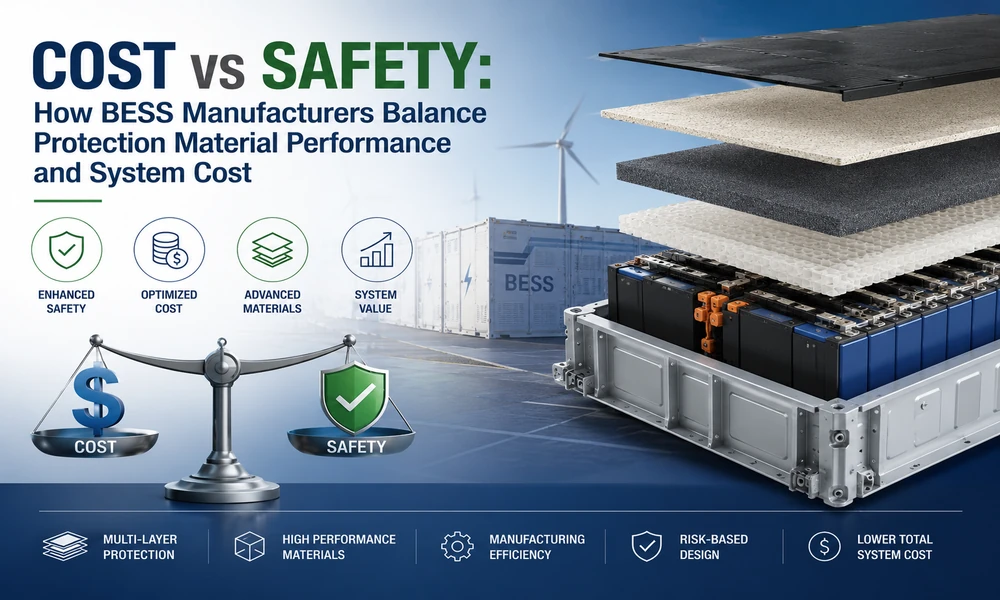
As the Battery Energy Storage System (BESS) market expands, manufacturers face a challenge that is becoming increasingly important: how to improve battery safety without making the system economically uncompetitive.
More thermal insulation, thicker barriers, higher-grade flame-retardant materials, and additional protection layers can potentially improve safety. However, every additional material also affects system cost, weight, available battery space, assembly efficiency, and ultimately the cost per kWh.
For BESS manufacturers, therefore, the real question is no longer simply, “Which material provides the highest thermal resistance?” Instead, it is:
Which combination of protection materials delivers sufficient safety performance at an acceptable total system cost?
This is changing how battery manufacturers evaluate thermal insulation and fire protection materials-from individual material specifications toward system-level value.
1. Safety Materials Are Becoming a System Cost Decision
In an energy storage system, safety protection exists at several levels.
At the cell level, insulation and flame-retardant materials can help provide electrical isolation and reduce the risk of localized failures affecting surrounding components. Materials such as PC insulation flame-retardant sheets may be used where electrical insulation, structural stability, and flame resistance need to be combined.
At the module level, the challenge becomes more strongly related to thermal propagation. Materials including CR foam, nano silica composite thermal insulation boards, and ceramifiable silicone foam can perform different functions such as thermal insulation, sealing, cushioning, flame resistance, and high-temperature protection.
At the pack level, materials such as PIR thermal insulation cushioning boards can contribute to both thermal protection and mechanical buffering within the overall enclosure.
This multi-level protection architecture creates an important commercial question.
Should manufacturers maximize protection at every level?
In most cases, that would not be economically or technically optimal. The better strategy is to distribute protection according to the actual risk and performance requirements of the battery architecture.
2. The Cheapest Material Does Not Always Produce the Lowest System Cost
Material purchasing teams naturally pay attention to price per square meter, kilogram, or component. But evaluating battery safety materials purely through unit price can create misleading conclusions.
Consider two insulation materials.
Material A may have a lower purchase price but require greater thickness to achieve the required thermal barrier performance. Material B may cost more per unit area but provide the necessary performance with a thinner layer.
The second solution could potentially create additional value through:
- reduced material consumption;
- lower component weight;
- more available internal pack space;
- simplified assembly;
- fewer protection components; and
- improved thermal propagation resistance.
For BESS manufacturers, this means the relevant metric should increasingly become cost per protected battery system rather than simply cost per kilogram of material.
An even more useful concept is cost per unit of safety performance.
If a higher-performance insulation material enables a manufacturer to reduce thickness, simplify the protection structure, or eliminate another component, its apparently higher purchasing price may result in a competitive overall system cost.
3. Thickness Is One of the Hidden Variables in the Cost-Safety Equation
Space is extremely valuable inside a battery pack.
Adding several millimeters of insulation around cells or modules may appear insignificant when examining an individual component. Across hundreds or thousands of cells, however, these additional layers can influence the volumetric efficiency of the entire BESS.
This creates a trade-off between:
thermal protection ↔ material thickness ↔ energy density ↔ system cost.
Consequently, material development is increasingly focused not only on achieving lower thermal conductivity but on delivering more protection within limited thickness.
Nano silica composite insulation materials illustrate this direction particularly well. Their value proposition is not simply that they resist heat. The commercial advantage comes when high thermal insulation performance can be achieved within a relatively constrained space.
The same principle applies to foams and cushioning materials. Manufacturers need enough compressibility and mechanical protection without unnecessarily increasing the spacing between components.
Therefore, performance per millimeter is becoming almost as important as performance per kilogram.
4. Multi-Functional Materials Can Reduce Total Protection Cost
One of the most effective ways to balance safety and cost is to make individual materials perform multiple functions.
Traditional battery pack design may use separate components for:
- thermal insulation;
- electrical insulation;
- flame retardancy;
- cushioning;
- sealing; and
- structural protection.
Every additional component introduces material cost, inventory requirements, assembly operations, quality-control procedures, and potential failure points.
Multi-functional materials can change this equation.
For example, a foam material capable of providing cushioning, sealing, and flame-retardant performance may potentially replace several separate layers. Similarly, ceramifiable silicone foam can provide conventional elastic protection during normal operation while forming a more heat-resistant barrier when exposed to extreme temperatures.
The economic value therefore extends beyond the price of the material itself.
A material costing 20% more is not necessarily expensive if it allows the manufacturer to remove two other components and simplify assembly.
This is why BESS manufacturers increasingly need to evaluate Total Installed Cost (TIC) rather than raw material price alone.
5. Protection Should Follow the Risk
Another important trend is moving away from uniform protection.
Not every location inside a BESS experiences the same thermal, electrical, or mechanical risk.
Areas between cells may require thin electrical and thermal barriers. Module boundaries may need stronger resistance to thermal propagation. Pack-level structures may prioritize insulation, mechanical cushioning, and fire containment.
A more cost-efficient architecture therefore allocates different materials according to different risk zones.
This can be summarized as:
Cell level → prevent and isolate
Module level → slow thermal propagation
Pack level → contain and protect
Such a layered strategy allows manufacturers to avoid over-engineering low-risk areas while concentrating higher-performance materials where they create the greatest safety benefit.
The result can be better safety economics without simply increasing material usage throughout the battery system.
6. Safety Investment Must Also Consider the Cost of Failure
There is another side to the cost equation that cannot be ignored: the potential financial impact of inadequate protection.
A battery safety incident can generate costs far beyond the damaged cells themselves. Depending on the situation, manufacturers and system operators may face system downtime, warranty claims, replacement costs, project delays, investigation expenses, insurance consequences, and reputational damage.
This makes battery protection materials a relatively small component with potentially significant influence on lifecycle risk.
The goal is therefore not to minimize safety-material spending.
It is to identify the point where additional investment produces meaningful reductions in system risk.
This distinction is important.
Cost optimization should mean removing unnecessary cost-not removing necessary protection.
7. From Material Price to System-Level Value
The BESS industry’s procurement criteria are likely to become increasingly sophisticated.
Instead of asking only:
“How much does this material cost?”
manufacturers will increasingly ask:
“What does this material allow us to save or improve elsewhere in the battery system?”
A more complete evaluation can consider five dimensions:
| Evaluation Area | Key Question |
|---|---|
| Safety Performance | Can it delay heat transfer, flame spread, or thermal propagation? |
| Space Efficiency | Can the required protection be achieved with less thickness? |
| Weight | Does it help reduce overall system mass? |
| Manufacturing | Can it simplify cutting, installation, and automated assembly? |
| System Cost | Can it reduce other materials, components, labor, or lifecycle risk? |
This approach fundamentally changes the relationship between BESS manufacturers and material suppliers.
Suppliers capable of understanding the complete cell-module-pack architecture can participate earlier in system design and help customers optimize combinations of insulation, cushioning, flame-retardant, and thermal barrier materials.