

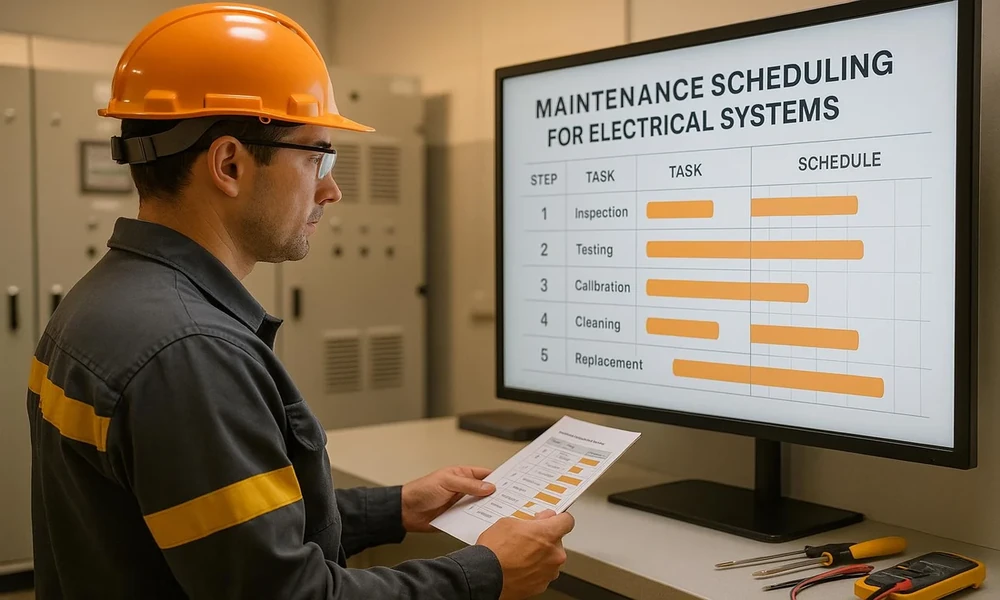
Most electrical failures in commercial and industrial buildings give some warning before they happen: a joint running warm, a breaker tripping more often, insulation slowly breaking down inside a cable. An inspection schedule is what turns those warnings into planned work instead of emergency call-outs. Effective electrical maintenance depends less on how often equipment is checked and more on checking the right things at the right intervals. This article sets out how to build a schedule that fits your installation and actually gets followed.
Start With a Complete Asset Register
A schedule is only as good as the list behind it. Begin by recording every significant piece of electrical equipment: high-tension switchgear, transformers, low-voltage main switchboards, distribution boards, motor control centres, standby generators, UPS systems and critical cables. Note the make, model, rating, installation date, location and current condition of each item. Many facilities discover forgotten equipment during this exercise, such as an old sub-board feeding a single plant room that nobody has opened in years.
Rank Equipment by Criticality
Not every asset deserves the same attention. A main switchboard feeding an entire building, or a transformer supplying a production line, carries far more risk than a lighting board in a store room. Rank each item by the consequences of its failure, considering safety, business disruption and replacement lead time. High-criticality assets should be inspected more often and with more thorough methods. This approach directs limited maintenance budgets to where they make the most difference. Equipment with long replacement lead times, such as large transformers or custom switchgear, should be ranked higher even if failures have been rare.
Understand the Regulatory Baseline
In Singapore, electrical installations above a certain capacity must be licensed by the Energy Market Authority, and electrical work must be carried out or supervised by a Licensed Electrical Worker. The appointed LEW is responsible for inspecting and testing the installation at intervals set by the regulations, depending on its type and capacity. These requirements form the minimum standard for any schedule. A good maintenance plan builds on this baseline rather than treating it as the full extent of what is needed.
Set Intervals by Equipment Type
Different equipment needs checking at different frequencies. A practical starting framework might look like this:
- Monthly: visual checks of switchrooms, indicator lamps and alarms
- Quarterly: thermal scanning of main switchboards under load
- Annually: servicing and testing of LV switchboards and breakers
- Every few years: detailed HT switchgear and transformer servicing during a shutdown
Manufacturers’ recommendations and the equipment’s condition should refine these intervals further.
Add Condition Monitoring Between Shutdowns
Routine servicing often needs equipment to be switched off, which limits how frequently it can be done. Condition monitoring fills the gaps by checking equipment while it remains energised. Thermal imaging detects hot joints, partial discharge testing identifies insulation deterioration in HT equipment, and oil analysis reveals the internal condition of oil-filled transformers. Including these in the schedule allows problems to be found and planned for without unnecessary interruptions.
Factor in Age and Operating Environment
Older equipment generally needs closer attention. Electrical apparatus that has been in service for around twenty-five years or more faces a higher risk of deterioration and failure. Harsh environments also shorten intervals: dusty plant rooms, humid basements, coastal sites and areas with vibration all accelerate wear. A reliable approach to electrical maintenance adjusts the schedule for these conditions rather than applying the same intervals everywhere across a site.
Coordinate With Operations
Inspection schedules fail when they clash with business operations. Work that requires a shutdown must be planned around production runs, tenant needs or events. Discuss the schedule with operations managers early, and agree windows for shutdowns months in advance where possible. Weekend or night work may be required for critical facilities. A schedule that operations teams understand and support is far more likely to be followed consistently. Publishing the year’s shutdown calendar early gives tenants and production teams time to prepare.
Keep Clear Records
Every inspection and test should be recorded, including findings, readings, actions taken and recommendations. Good records allow trends to be spotted, such as a joint temperature creeping upward over successive thermal scans. They also provide evidence of compliance and support decisions about repair or replacement. Digital maintenance systems make it easier to track due dates and retrieve past reports when needed, and they reduce the chance of an item being forgotten.
Review the Schedule Regularly
A schedule should evolve over time. Review it at least once a year, considering:
- Faults or failures that occurred since the last review
- Trends in test results and thermal scans
- Changes in load, equipment or building use
- New equipment added to the installation
Adjusting intervals based on real experience keeps the schedule relevant and effective.
Putting the Schedule Into Practice
A well-built inspection schedule reduces unplanned outages, improves safety and extends equipment life. It starts with a clear asset list, ranks risk sensibly and combines routine servicing with condition monitoring. For facilities that need help designing or carrying out such a programme, a specialist in HT and LV switchgear servicing and testing can assess the installation and recommend practical intervals.